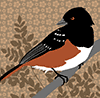
I see them chasing each other, but the magical moment where one pecks my head is still just a dream...
And just because, here is a video of the Brewer's Blackbird's cousins, Red-Winged Blackbirds, singing in Briones:
I see them chasing each other, but the magical moment where one pecks my head is still just a dream... When she saw me photographing her, she looked a bit indignant, then waddled off.
 Resident pelican is getting all decked out in bright orange, head tuft, and the beginning of a beak bump poking out from behind the wing...
 Eared grebes still going strong, but they'll be gone any time now...
  I think I bore them: they're always yawning when I approach. Right before they dive underwater to show just how jaded they are.
 A rare sighting of a land cormorant. It was pulling at some frayed string at the edge of the rowing dock. Nest materials perhaps?
 Night heron with green and gray stripe background.
 Some cheerful humans who got excited when they saw me pointing my camera into trees. So I took their picture too. They waved (not pictured).
 Friends!
 One thing I like about cormorants is the texture of their feathers. At a distance they look plain black, but up close, they are beautifully scaly. Each one of the edges you can see here is the result of a thin black border to the individual feathers. And see how the back feathers don't have that scaliness?
 I love the shy-looking cormorant. Another subtle detail is the stripy beak.
 Here's another cormorant that has a much more impressive crest. Maybe that's a triple crest?
 You know it's spring when the pink flowers are blooming, and the cormorants are perching in dead trees, grunting like pigs.
 Here you can see the big lobed feet typical of grebes:
 And this one's just pretty. Worth clicking to see larger, it came out pretty crisp.
 Yawn and foot stretch!
 I have never heard an eared grebe make a sound. It's probably saving up its squawking energy for when it reaches its breeding grounds, probably some inland freshwater pond.
 After another year, they get the classic gull look: grey back, white body. The bottom gull is, I think, younger or at least more pathetic than the one above. Its legs and bill are a duller yellow than the one on top. Note that the one on top has a slightly streaky, mottled head. It's not quite in breeding shape yet. I noticed that the tip of the beak on both of these birds isn't a "ring" but a solid tip, so I'll make a guess that both of them are second years and not quite mature. (Gosh, do NOT tell me I'm going to have to buy one of those special guides to the 1001 indistinguishable looks of one kind of gull.)
 Now this dude or lady is getting there. The head looks all clean and smooth, the bill is properly ringy.

 But in spring, the testosterone of both males and females sparks the growth of a reddish callus:
 ...which can get gigantic and menacing.
 I took all these coot pictures on the same day. So, why do they have different sized bumps? Gullion says that the most dominant coots--those defending a territory--are the ones with the biggest bumps, and the others are lower on the pecking order. Some coots stay on a territory year-round, and keep their red shield, too. I am wondering, do coots on Lake Merrit have a territory? Do they actually nest there? They are supposed to prefer freshwater. I've never seen a baby coot at the Lake. What are they defending if not nest sites? Are they just testosterone fueled jerks that will fight regardless?